
HCRS National Core · Module 11
See how one HCRS lesson actually works.
Lesson 11.1 moves a learner from a payer-reported denial to a disciplined decision: diagnose the cause, protect the deadline, choose the recovery lane, assign ownership and preserve the evidence.
The operating problem
A denial tells you what the payer did. It does not always tell you why the revenue failed.
The lesson teaches a professional to separate the reported result from the underlying cause, work from the exact claim and controlling source, protect the deadline and avoid repeating the same unsupported action.
Teach the operating principle
Start with the distinction that changes the decision.
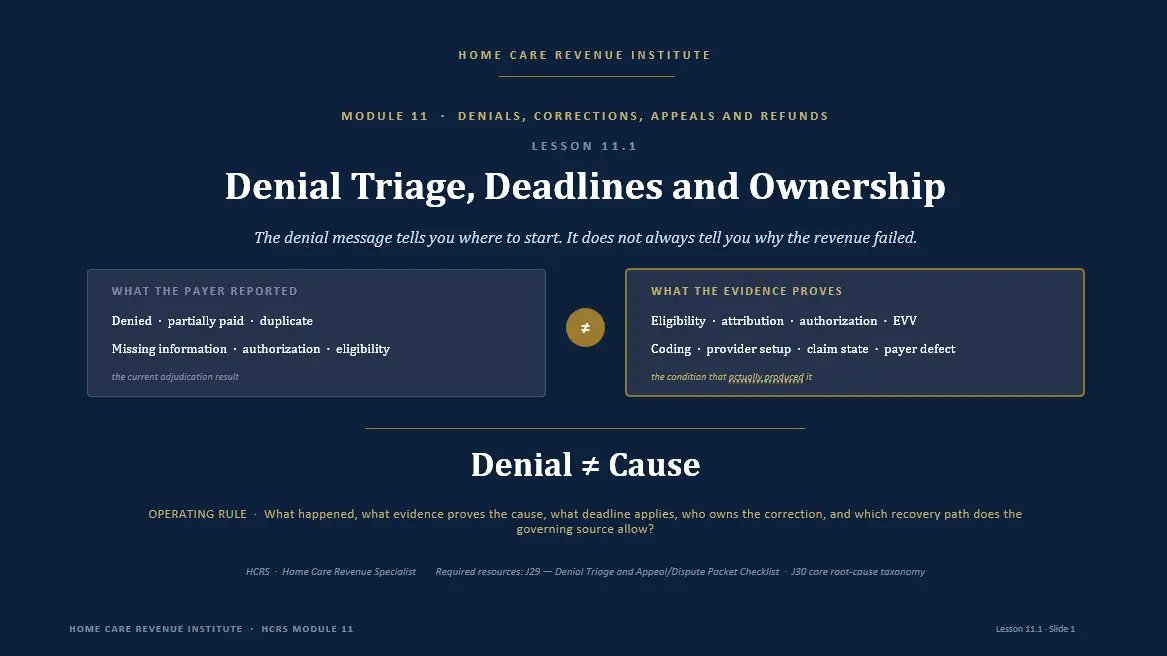
The visual lesson establishes the core rule first: the denial result and the verified cause are not the same thing.
Reinforce the lesson in writing
Give the learner a durable explanation—not a transcript.
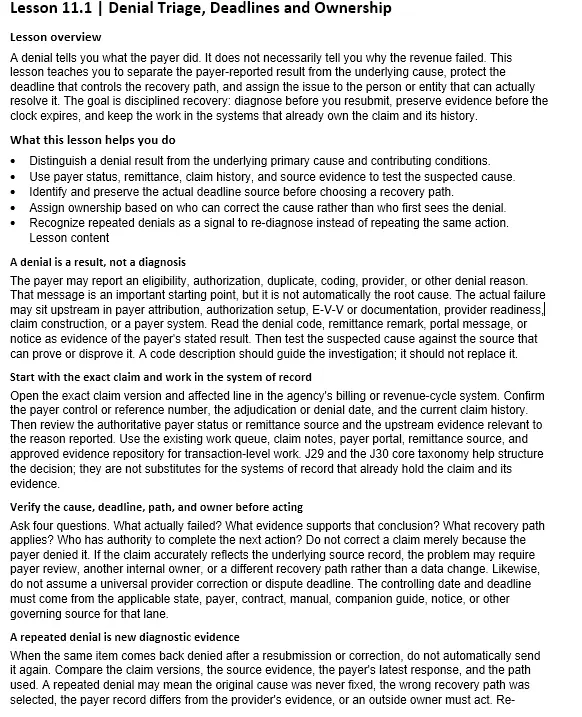
The lesson body restates the decision logic in a form the learner can review after the video. It explains how to test the suspected cause, protect the deadline and keep the work inside the existing system of record.
- Separate result from primary cause and contributing conditions
- Use payer status, remittance, claim history and source evidence
- Assign ownership to the person who can correct the cause
- Treat repeat denials as a signal to re-diagnose
Apply the judgment
Require a decision before showing a model answer.
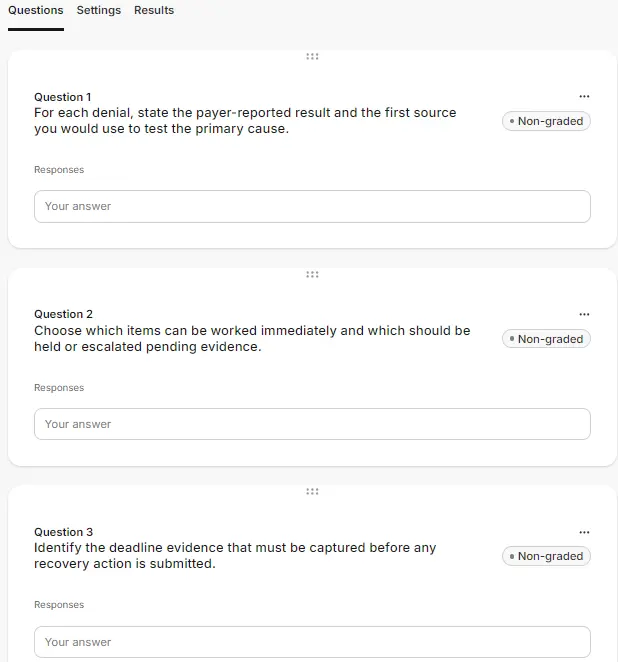
The applied exercise makes the learner work through the operating questions instead of merely recognizing a definition.
- State the payer-reported result and the first source used to test the cause.
- Decide what can be worked now and what must be held or escalated.
- Identify the deadline evidence that must be captured before submission.
Completion proves engagement. The model solution then shows the reasoning standard the learner should be able to defend.
Check the operating logic
Test whether the learner can select the defensible next action.
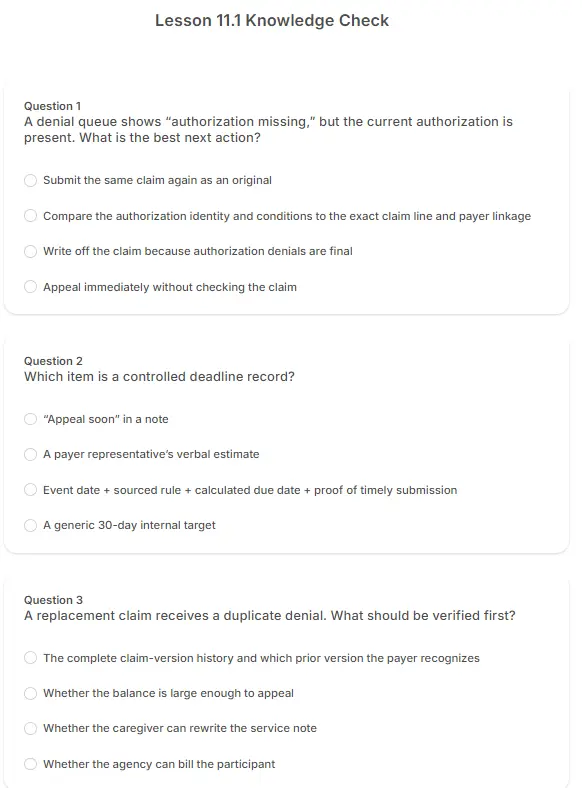
The knowledge check tests application across authorization, deadline control and claim-version history. The distractors are plausible shortcuts a working biller may be tempted to take.
Take the method into the work
A job aid should support the decision—not become another system to maintain.
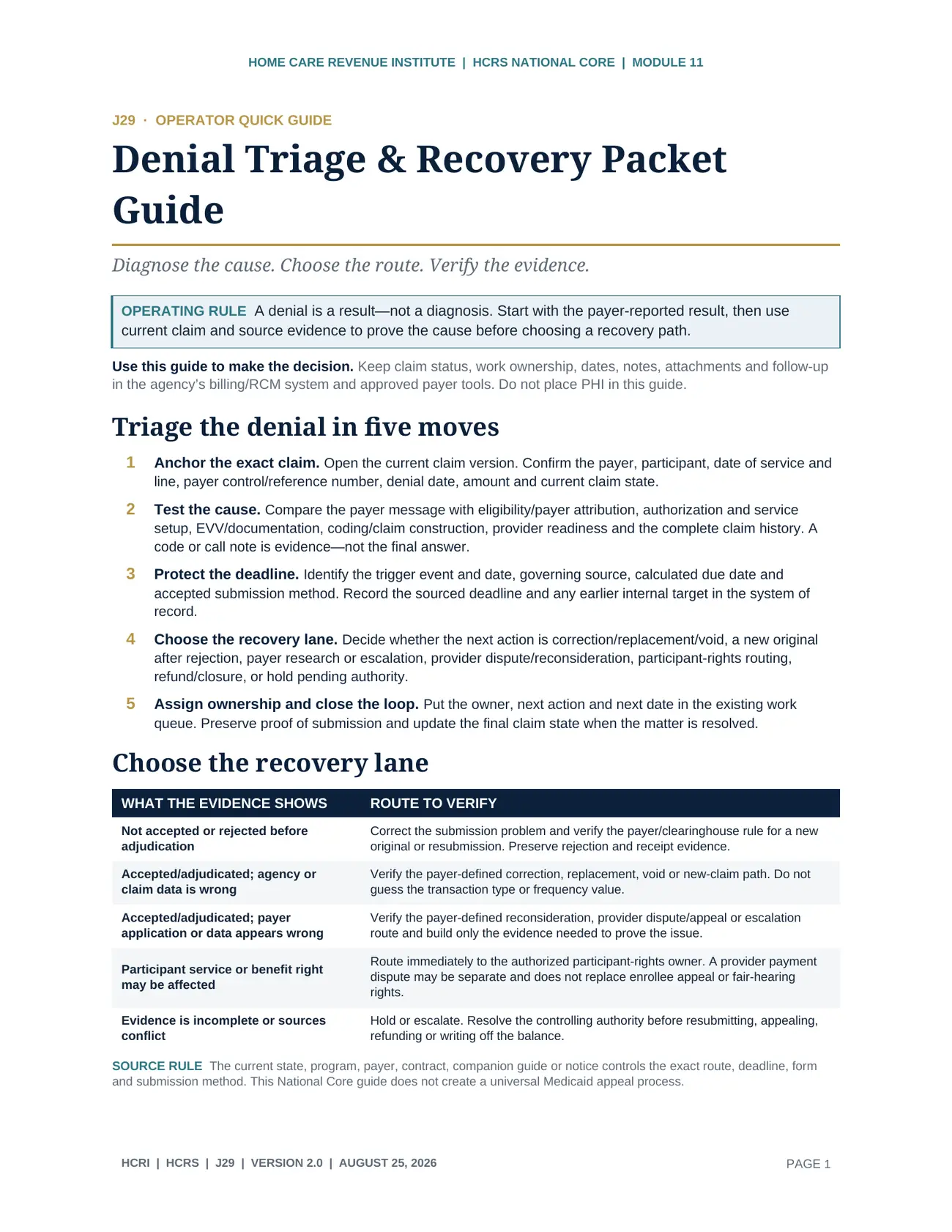
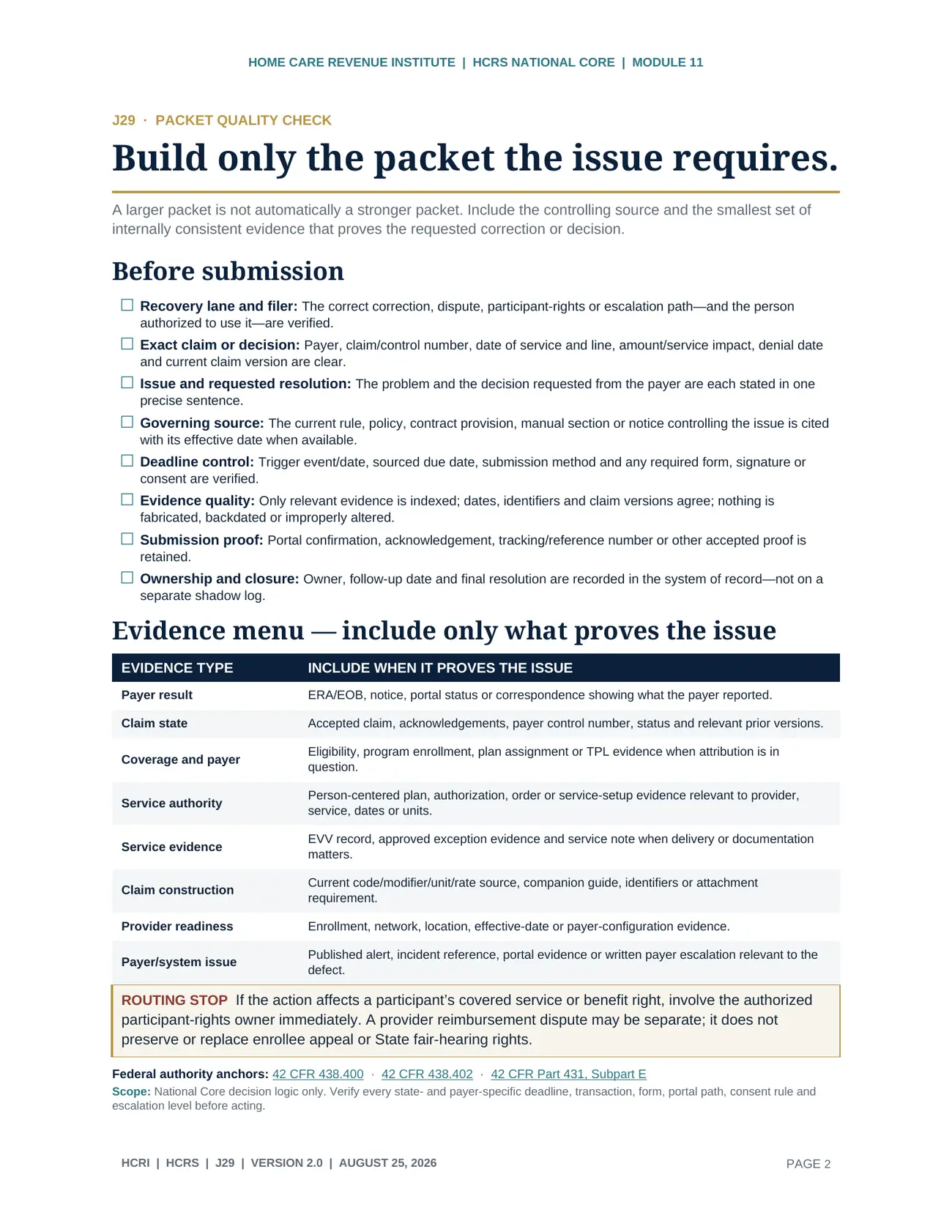
J29 is a two-page operator guide. It does not duplicate the billing platform, payer portal or work queue. It helps the professional choose the recovery lane and verify packet quality at the point of work.
What this proves
HCRS connects instruction, practice, assessment and real-work transfer.

You have seen the work
If this is the level of judgment your role requires, take the next step.
Founding Cohort enrollment is open now. Review the complete enrollment options, state qualification, payment flexibility and published terms before purchase.